
Day’s Ferry Congregational Church
Gathering More Than Two Hundred and Fifty Years of History
I was called to become the settled pastor of Day’s Ferry Congregational Church in the fall of 2011. My last Sunday in the pulpit was in mid-October of 2018, essentially seven years later. Despite my writing a history of this church, I have no continuing relationship with the church and its congregation. All the information in my history will derive from publicly-available sources, and not from any information shared with me by members, either privately or in church gatherings. Former pastors are required to pay attention to such boundaries in order to allow the congregation and its new pastor to develop their own relationship, unimpeded by relations with previous clergy.
On Sunday, September 17, 2023, Reverend Dr. Alan Baughcum presented a portion of his research about the history of the Congregational Church in Woolwich.
Read the complete text of presentation >
View the slides featured in the presentation >
Watch a video of the presentation >
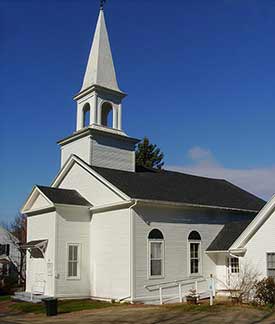
The original Congregational Church in Woolwich, Maine was built in 1765, a year before the founding of the town itself. The building that houses the Day’s Ferry Congregational Church, an outreach of that original congregation, is located along the bank of the Kennebec River in Woolwich, Maine and was built in 1833. Today, it stands as a classic part of the coastal horizon, a quintessential New England-style white clapboard building complete with a bell tower and spire. Those who engage with the history of this church will have the fortune of uncovering its lessons in adaptation, creativity, innovation and faithful persistence.
By assembling information and records for the more than two-hundred fifty years centuries of the church’s history, my aim is to bring to life the people and events that passed through it. By digitizing material, photos, and documents, and calling for others to share their memories and ephemera, we can ensure the unique history of this Maine church will be preserved.
Contribute to Our Living History
Do you have files, photos, documents, or other materials that would lend to a more robust understanding of the historic Day’s Ferry Congregational Church? Please contact us. Your contribution will serve as a valuable part of Rev. Baughcum’s research for a book about the history of the church.
When I was growing up, all the children in the church of my youth had to recite a memorized Bible verse every Sunday. I frequently quoted one of the commandments, in the King James translation of the Bible of course…Honor thy father and thy mother: that thy days may be long upon the land which the LORD thy God giveth thee…Ex 20:12.
God expected the people of Israel to occupy their promised land for as long as they were obedient. So God provided them with statutes and ordinances, laid out explicitly in Deuteronomy, that would guide them in making the right choices and in being obedient to God. The people of God would possess the land as long as they were obedient to God, as long as they obeyed God’s statutes and ordinances.
What then explains the long tenure of Congregational Church in Woolwich? Starting with the First Congregational Church (i.e., the Nequasset Church) founded in 1765, the church is now 254 years old, older than the United States. The United States government has a constitution that causes it to cohere and gives it meaning and direction. What does the church have that has sustained it for so long?
A note: in my discussion of the history of the church, I begin with the founding of the Nequasset Church (the building across from Woolwich Town Hall) in 1765. As I have studied, I have learned that the people and ministers of both DFCC and the Nequasset Church viewed each as one church. Church clerks over the years have reported data on membership and giving as if the two were one church. The parsonage for Congregational ministers, now burned down, was inhabited by ministers who served both churches.
Until Nancy Coffin became Clerk in the 1980s very little information about DFCC was saved. (She was ably followed by Annie Miller, and now Sally Davis.) They have my undying gratitude for their work in recording the history at DFCC and preserving it. Even so, there is no collection of sermons by DFCC ministers…except, now, for mine on this website.
I am indebted to Rev. H. O. Thayer, a former minister of this church in the late 19th century (1867-1883), for his book on the history of the two Congregational Churches in Woolwich. And much of that history revolves around Rev. Josiah Winship, the first pastor at Nequasset, serving 59 years. And again, to my amazement, every one of those years in a church without any heat!!
Rev. Josiah Winship was a graduate of Harvard College and came to Woolwich from Cambridge. He and six other men, forming seven in total, were the founders and first members of the church in 1765.
There were others who would have joined but Winship adopted a common Congregational protocol of the time in founding the church on seven “pillars.” Those pillars were taken from Proverbs 9:1 which tells us that Wisdom founded her house on seven pillars. Rev. Dr. Cotton Mather, a prominent Puritan clergyman, taught that Wisdom’s method was also the way that Wisdom created the church on earth. So, seven members were needed for the founding of a church.
Rev. Winship and six others from Woolwich signed their names to a covenant that tells something about the beliefs of the Nequasset Church. First, the Bible was everything to our Congregational forebears; they turned to it for advice on everything. Second, they believed in an educated clergy, insisting on a man with academic training for the pulpit and following the instruction of the most learned man in early America for their church’s founding.
The Covenant those seven men signed, yes, they were all men…that Covenant (attached) tells us several things. Read the first couple of paragraphs…First, they believed in using extremely long sentences and in using the word “ye” as often as possible.
By and large they were Calvinists. Calvinism consisted of several principles, one being that human beings, by virtue of Adam’s sin, were utterly and totally depraved and completely dependent on God’s grace for salvation. Take a look at the preamble to the covenant. Pay attention to words of self-description like “humble,” “unworthyness,” “liableness and proneness to backslide,” and “renouncing all confidence in ourselves.”
They really, really believed in the Bible…see the first paragraph.
They believed in covenanting among themselves for church organization and belief and function. Congregationalists still covenant among ourselves in the church today but we also have adopted statements of faith. See for example DFCC’s Statement of Faith and the UCC Statement of Faith that accompanied this discussion. Those Statements of Faith serve us as shorthand guides to the teachings of the Bible. Each line can be linked directly to Scripture…just ask me …. I did precisely that in my Systematic Theology courses in seminary. Even so, like our forebears, modern Congregationalists do not require new members to voice agreement with any creed or statement of faith.
The seven pillars saw themselves as being in communion with other Congregational Churches. Together the Congregational Churches will work to prepare the “path and order of God’s Gospel among us.” Each Congregational church is in relationship with other Congregational Churches wherever they are.
Another principle of Calvinism was that God had elected, had predestined certain of humanity to be faithful and persevere in faith until the great resurrection at the end of time. However, Baptists, and others, follow the Arminian theology that humans have free will and can say no to God. It is therefore important for Baptist exhorters and ministers to preach the word of God that will offer salvation to humans who say “yes” to God and accept salvation through Jesus’ sacrifice on the cross. People are called to salvation by ministers, whether educated or not, who preach the Scriptures.
Interestingly these folks do accept the Calvinist proposition that humans are totally depraved and entirely deserving of the punishments of hell unless saved. In fact, the church of my youth was one of these so-called Presbyterian Baptist churches.
So, these folks, these Baptists, were present in the Nequasset congregation. They made Rev. Winship’s tenure as minister quite tempestuous. In fact, Rev. Winship had to undergo a trial to determine whether his theology of salvation was up to snuff. His ministry at Nequasset survived but the Baptists eventually left to form what became two Baptist churches in Woolwich.
The old disputes do linger. There have been people who have decided not to be a part of DFCC because the pastor does not preach sermons on the total depravity and unworthiness of humanity. Even if I believed that, and I do not, I would not preach it, if only for quite pragmatic reasons. I much prefer that people learn of the joy of obedience and service to God through our Savior Jesus Christ. I grew up in a church where the preacher lambasted humanity for its sinfulness every Sunday for the twenty-one years I was there. That did not make me want to join the church…actually that preaching and teaching caused me to run away from the church for nearly a decade of my life.
So far as I can tell the basic beliefs as stated in the Covenant of the seven pillars have persisted throughout Congregational history: Bible, educated ministers, covenant, and relationship with other Congregational Churches.
In an effort to test the proposition that the rather mainstream (for their time) religious principles established at Nequasset have persisted, I tried to measure the temper of the town of Woolwich by looking at how its people have voted over time. My guess is that a town that is pretty much mainstream in its political thinking is going to be mainstream in its theology. Put another way, if a town swings wildly in its voting from election to election from right to left and back again, that suggests a certain diversity and unsettledness in its political thinking that may also be reflected in the diversity and unsettledness of its theological beliefs.
I am happy to be challenged on these propositions by the way. I could be completely wrong but I don’t think so.
I collected data on how Woolwich has voted in the 58 Presidential elections from 1788 through 2016. Just a word about that data: it is very hard to dig up. There are databases with voting results on the Internet and elsewhere but they do not go below the county level. Finding out how a small town like Woolwich voted took me to dusty corners and ancient, desiccated newspapers at libraries in Bath, Brunswick, Portland, Augusta, and the far corners of the Internet. It took a very long time and a lot of searching. I say that not to pat myself on the back so much as a warning to anyone else who tries to find out how their hometown voted.
Basically, Woolwich has pretty much voted in the mainstream. Assume that the Federalists and Whigs were pre-cursors of the Republican Party. If I counted correctly Woolwich has voted Republican in 43 of 58 Presidential elections. Loved Teddy Roosevelt…Franklin, well, not so much, carrying the voters of Woolwich in only one of his four elections.
However, in recent elections that pattern seems to have disappeared. Woolwich has gone Democrat in four of the last six Presidential elections. Still mainstream but perhaps a shift to left of center from right of center? However, Woolwich did vote, by a near-majority, 49.8%, of its votes, for Donald Trump in 2016.
There are several interesting items that registered with me in looking at the details of Woolwich’s voting history. For example, slightly more than 20% of Woolwich’s votes in 1844 went to the Liberty Party, an abolitionist party and a forerunner of the Republican Party. That independent streak shows up again in 7 and 8 percentage point votes for John Anderson and Ralph Nader in 1980 and 2000, respectively. In 2012 the Libertarian Party got 11% of Woolwich’s vote. And the real surprise for me: Ross Perot got a plurality, barely, 34%, of the Woolwich vote back in 1982 …. more than any other candidate!!
So, call Woolwich politically mainstream with an independent streak. That’s not a bad way to be, in my opinion, either politically or theologically.
As noted, DFCC has been strong in its desire to maintain a relationship, a communion, with other Congregational Churches. I want to assert that DFCC, in its own way, has been quite ecumenical in its relationship with other churches, not just Congregational churches.
A congregation is known by its people. What do you know about the scholarly Rev. H. O. Thayer? What about the dedication of Ellen Warren who gave so much of herself to this church, including 50 years at the organ? Frank Walker? So many people … dedicated, important, and remarkable people…
“We whose names are under written, apprehending ourselves to be called of God to enter into a Church State, or into a Christian Society, for mutual communion, and for ye regular settlement of the ordinances of Christ among us, Do in a humble sense of our unworthiness of such a favor, and unfitness for such a service, knowing our liableness and our proneness to backslide, and renouncing all confidence in ourselves, and relying on ye Lord Jesus Christ ye head of ye Church for help and grace, covenant before God and with one another in manner following —” Viz. —
- First; — We do received ye Scriptures of the Old and New Testament as given by inspiration of God, as ye only sure and sufficient rule of faith and practice, declaring and promising that by ye help of God, we do and shall endeavor at all times to regulate our faith, and conduct ourselves both toward God and toward one another, according to what we find to be taught therein.
- We recognize ye Covenant of grace, that we in a public and solemn manner entered into when we joined ourselves to ye Church of Christ, humbly imploring ye mercy of God thro’ ye Mediator, devoting ourselves to his fear and service, and depending upon His power and grace, for all ye assistance that we need, promising by ye help of ye divine spirit to order our conversation so as to adorn ye doctrine of God our Savior in all things.
- We do now likewise give up ourselves to one another in ye Lord, resolving by his help, to treat each other as fellow members of ye same Body, in brotherly love and holy watchfulness, for mutual edification; and to subject ourselves to all ye hold administrations appointed by him who is ye head of ye Church dispensed according to ye rules of ye gospel, and to give our constant attendance in all ye public ordinances of Christ as becometh saints.
- We acknowledge our posterity to be included with us in ye Gospel Covenant; and blessing God for so rich a favor, do promise to bring them up in ye nurture and admonition of ye Lord, and acknowledge and treat them in their covenant relation according to ye rules of ye gospel.
- Furthermore, we promise our utmost care and diligent endeavor to have all such offices and officers as Christ has appointed for ye edification of his Church settled and continued among us, and that we will do our duty faithfully for their maintenance and encouragement and carry it toward them with that respect and honor as becomes ye disciples of Christ.
- Finally, we acknowledge and promise to preserve Communion with the faithful Churches of Christ, for giving and receiving mutual and assistance in all cases that call for it, declaring that according to our light and understanding we are of ye same principles (substance) with the Congregational Churches of New England, respecting their doctrine and government and that we will endeavor to prepare ye path and orders of ye Gospel among us.
Now ye good Lord be merciful to us, and as he has thus put it into our hearts to devoted ourselves to him, let him pity and pardon our frailties, humble us out of all carnal confidence and keep these things forever on our hearts, to his own glory and our own peace and comfort here and our future and eternal happiness — Thro’ Jesus Christ to whom be glory forever and ever — Woolwich June 12, 1765 Josiah Winship, Pastor, and Samuel Ford, Jonathan Reed, Benjamin Shaw, Joshua Bayley, Samuel Blanchard, Nathaniel Thwing.
- Bylaws of Day’s Ferry Congregational Church
- United Church of Christ Statement of Faith—Original Version
ARTICLE II. PURPOSE
The purpose of the Day’s Ferry Congregational Church shall be to establish opportunities for followers of Jesus, the Christ, to gather for worship, fellowship, study, outreach and service.
ARTICLE III. STATEMENT OF FAITH
We believe in one God, Three-in-One, One-in-Three: God the Father and Creator, Jesus Christ, Son and Redeemer, and the Holy Spirit, Eternal Counselor.
We believe in God, the Creator, who calls the world into being and who calls us into relationship with the Divine and with one another.
We believe in Jesus, the Christ, who calls us to follow the example of forgiveness, generosity, and compassion.
We believe in the Holy Spirit, the Comforter, who calls us to study and service.
This church acknowledges Jesus, the Christ, as its head. We rely on the guidance of the Holy Spirit to lead each person in faith as revealed by the Holy Scriptures, reason, and conscience.
God calls us to live in justice and peace, to embrace tradition and to envision the future. We are witnesses to the power of faith, hope and love embodied in the gospel. We strive to know and to respond to the will of God and to the needs of people. We welcome into our fellowship all those who seek God’s truth, and we rely on God’s grace to guide us as we walk together.
We believe in God, the Eternal Spirit, Father of our Lord Jesus Christ and our Father, and to his deeds we testify:
He calls the worlds into being, creates man in his own image and sets before him the ways of life and death.
He seeks in holy love to save all people from aimlessness and sin.
He judges men and nations by his righteous will declared through prophets and apostles.
In Jesus Christ, the man of Nazareth, our crucified and risen Lord,he has come to us and shared our common lot, conquering sin and death and reconciling the world to himself.
He bestows upon us his Holy Spirit, creating and renewing the church of Jesus Christ, binding in covenant faithful people of all ages, tongues, and races.
He calls us into his church to accept the cost and joy of discipleship, to be his servants in the service of men, to proclaim the gospel to all the world and resist the powers of evil, to share in Christ’s baptism and eat at his table, to join him in his passion and victory.
He promises to all who trust him forgiveness of sins and fullness of grace, courage in the struggle for justice and peace, his presence in trial and rejoicing, and eternal life in his kingdom which has no end.
Blessing and honor, glory and power be unto him.
Amen.
- Ecumenicism And Day’s Ferry Congregational Church
- Notables And Structures At Day’s Ferry Congregational Church
Folks at Day’s Ferry come out of a wide variety of religious backgrounds…Baptist, Lutheran, Congregational, Presbyterian, Methodist, Episcopal, Greek Orthodox, Catholic, Unitarian, Evangelical & Reform…All told, the congregation has at least ten different Christian communities represented.
It was not always thus. Woolwich started with a very limited number of Christian communions. Roman Catholic priests tried to establish churches among white folks and among Native Americans in Maine long before Congregationalism came to Maine in 1765. Did not seem to stick.
Most of the people who came into Maine were English, Scotch, Irish. They brought with them Congregationalism and Presbyterianism and that was about it. The first church in Woolwich, the first church Down East of Brunswick was the Nequasset Congregational Church. But there was tension…a portion of that congregation was uncomfortable with Congregationalism. That portion broke off and formed a Baptist church, a Baptist church that incorporated some of the principles of Presbyterianism.
That Baptist church later became two Baptist churches…having grown up a Baptist, I can tell you that Baptists like nothing more than splitting off to form one’s own church…Woolwich still has two Baptist churches. The founder of Baptists in this country, Roger Williams, was so fond of splitting up his churches that, by the time of his death, he had completely split from all of them…sadly, he was left as a one-person congregation.
Over the years there have been a couple of additional churches in Woolwich: two Methodist churches…the South Woolwich Methodist Church and the North Woolwich Methodist Church.
For a good bit of the history of the Congregational Church in Woolwich, the church limited itself to relationships with other Congregational churches. For example, when the pastor of the church, Rev. Josiah Winship, was ordained as part of the formation of the church, the ordination was accomplished by pastors from other Congregational churches: Cambridge, Weymouth, and Bolton (Thomas Goss) in Massachusetts; and from Brunswick (John Miller), Harpswell (Samuel Eaton), Yarmouth (Edward Brooks), and Falmouth (Samuel Deane) in Maine.
Some years later when a council was formed to examine Rev. Winship’s theology, another group of Congregational pastors, this time all from Maine, was called to populate that council: Wells (Dr. Moses Hemmenway), Yarmouth (Rev. Tristram Gilman), Harpswell (Rev. Samuel Eaton), Cape Elizabeth (Rev. Ephraim Clarke), Portland (Rev. Samuel Deane), Westbrook (Rev. Thomas Brown), Falmouth (Rev. Samuel Willard), Buston (Rev. Paul Coffin), and York (Rev. Samuel Langton).
The church was helped in many years of its existence by the Massachusetts and then the Maine Missionary Society. Rev. Henry Thayer noted in his history of the church that DFCC should always maintain “a lively and grateful sense of obligation to that mothering hand.”
Part of DFCC’s connection with the Missionary Society came in the person of Rev. Jonathan E. Adams. He was the son of the second pastor of the Nequasset Church and was born and raised in Woolwich. Rev. Adams served as Secretary of the Missionary Society from 1876-1895. And he gave the dedication sermon in 1890 when this church was reconstructed.
DFCC’s involvement with other churches was not limited to Congregational churches. In the May 4, 1948 issue of the Bath Independent, I found a wonderful story involving the Baptists: “At the turn of the century [1800] an active Baptist group was organized in town and there was considerable rivalry between the sects. As the [Nequasset] church had been built by a tax on the entire town, the Baptists, having no church of their own, asked leave to meet there occasionally. This privilege was refused until 1811 when the society was allowed to use the meeting house for two successive week days ‘to meet in Association.’ At this meeting a petition to the governor was drawn up seeking an educational institution to train ministers, which resulted in the creation of Colby college in 1813.”
More involvement with the Baptists and other Woolwich churches: In his history Rev. Thayer tells us that in 1878-79 there was a general religious awakening in Woolwich. Two evangelists who had been preaching at the Baptist churches expanded their efforts town-wide into the six churches then in existence in town (two Congregational, two Methodist, two Baptist). In the winter evangelistic services were held both at the Nequasset church and the church here in Day’s Ferry, then termed “West Woolwich.” Rev. Thayer noted that he entered 15 new members as a result of the revival. The Congregational Yearbook reports a total of 32 people who became members by profession of faith, a number that must include both Day’s Ferry and the Nequasset Church.
Congregational ministers have never been big fans of revivals or, frankly, of evangelism. They have regarded such activity as unseemly and un-theological “enthusiasms.” And so it is not surprising to read of Rev. Thayer’s evaluation of his experience during this awakening in Woolwich. (p. 77) “Yet often looking back upon the winter’s religious upheaval and acknowledging the positive gain by tests of human judgment, I seem to feel it was a shining nightmare, a perversion of true religious methods. I should recoil from the same again.”
In addition to the variety of religious backgrounds of current members, Day’s Ferry has enjoyed the services of ministers from a variety of backgrounds. Edwin D. Hardin, minister from 1917-23, was Presbyterian. Oswald Rankin was a Baptist minister in 1922 and 1923. Benjamin Shaw, a Methodist, ministered in 1923 and 1924. Luther Swank was a Lutheran minister in 1926-1927. Shane Estes was a Baptist Student minister in 1964-66 as was John Ratliff in 1985 and 1986. Other Methodist ministers include William Rand Jr. (1932), Frank Hayward and Peter Willard (1969-1986).
Part of the reason for Day’s Ferry’s apparent openness to other Christian communions may have been purely practical, a matter of adapting to changed circumstances. Prior to 1927 the only way to cross the Kennebec River and proceed beyond Bath was by ferry across the river. The various ferries in operation terminated in Day’s Ferry. That personal and vehicular and freight traffic created the possibility for economic growth and development and concomitant population growth here.
When the Carlton Bridge was built across the river in 1927, an era came to an end. The ferries were now obsolete since people and freight had a quicker and, despite the toll on the bridge, a cheaper means of crossing the Kennebec. There was already an agricultural depression in this country in the 1920s, even before the Great Depression of the 1930s. The area had also been hit hard by the decline in wooden ship-building. Day’s Ferry and Woolwich really went into a decline, as did the churches.
In an effort to survive and continue the churches in Woolwich entered into an organization named the Woolwich Union for Church Services. It is not entirely clear whether that Union included the Baptists but it certainly included the two Congregational churches and the Methodists.
I have found very little documentation for this Woolwich Union. It is mentioned only a few times in the newspapers of the time. The Union was founded in 1927, had bylaws and semi-annual business meetings. At a minimum it coordinated the worship services and the offering of communion as late as 1942. It also sponsored suppers to raise funds to supply the Union’s needs.
I find mention in the newspapers of “Woolwich Community Churches” in 1945 and 1946. But no mention of the Union after 1942. I invite anyone with information about the Woolwich Union of Christian Services to please contact me.
Despite joining together in the Woolwich Union, all three churches eventually declined to the point that they stopped meeting. The Methodists closed in 1943. Day’s Ferry was down to 21 members in the late 1950s, and the facilities had deteriorated to the point they could not be used. The Nequasset congregation fell away to near-nothing and the property was turned over to the town.
I find it fascinating that, at a time in the rest of the United States when Christianity was booming and hitting its economic and demographic peak, these mainline Protestant churches in Woolwich fell upon their hardest times. (I have no information on the numbers attending the Baptist churches in Woolwich during that period. The printed history of the Montsweag church provides no data on the subject.)
A bequest by Frank Walker (more about him later) made it possible for the Methodists to re-open in 1957. The same gift, shared with Day’s Ferry, reactivated that congregation. Day’s Ferry and the North Woolwich Methodists formed the United Parish in 1967, a union that lasted for the next twenty years.
The Teacher of Proverbs (22:2) tells us that “The rich and the poor have this in common:
the LORD is the maker of them all.” How natural it is…and what a great example our forebears have set for us in sharing…how natural it is for us to seek out one another and join together in worship and thanksgiving and, where possible, mission and ministry.
Later teachers (songwriters…it’s always the songwriters!) expanded on the Teacher’s message in Proverbs:
The rich and the poor,
they’ve got this in common.
The Lord is the maker of ’em all.
The bum in the boxcar,
the guitar-pickin’ rock star.
The Lord is the maker of ’em all
Hallelujah! Hallelujah!
He knows when the sparrow flies,
and when that sparrow falls.
The quiet and the loud,
the humble and the proud.
The Lord is the maker of ’em all.
The lost and the found,
they’ve got this in common.
The Lord is the maker of ’em all.
The hands that have to fight,
the hands that pray for peace at night.
The Lord is the maker of ’em all.
Hallelujah! Hallelujah!
The left and the right,
the black and the white.
The Lord is the maker of ’em all.
The losers and the winners.
the saints and the sinners.
Yes, the Lord is the maker of us all.
Who are the significant people in our own history here at Day’s Ferry Congregational Church? I have mentioned Josiah Winship, the first pastor at Nequasset, a lot. I could tell you about his second wife, a woman so physically strong that she could churn butter simultaneously, one churn to each arm.
I have also mentioned another pastor, Henry Thayer. He was one of the founders of the Sagahadoc County and Maine Historical Societies in addition to his service to this church.
Henry Thayer, as did other of our ministers here, lived in a parsonage that was located here on Old Stage Road, east of Nancy Coffin’s home and 50 feet west of the house that is now owned by Greg and Susan Doak. The parsonage burned in 1940.
Cleveland Buck then owned what is now the Doaks’ house. He was able to save his place only because he had 1800 gallons of water in a cistern. The paint on his house was scorched but the house was saved. And of course if that house had gone up in fire, our church might have been lost as well.
Where did that parsonage come from? Well, it was built with money from two gifts to the church. The larger of the two gifts came from the estate of Peleg and Eleanor Tallman, members of the Nequasset Church in the early part of the 1800s.
Peleg was born in 1764 and died in 1840. He served the nation during the Revolutionary War and lost an arm in that service. He served one term in Congress when we were still part of Massachusetts. He grew wealthy in the shipping business in Bath. He and his family lived in a very large home in Bath near what is now the waterfront park along the Kennebec River. (The house is no longer there.)
Peleg was of one of four very wealthy and powerful Mainers who pretty much ran the state in the early part of the 1800s. When Peleg died, he left his family very well off. His wife, Eleanor, later gave the church a gift of $500 from her inheritance for the purpose of building a parsonage. Martha Trott added $75 and the house was built.
This church building was constructed in 1833. It did not then have a bell tower spire. It had four spire-lettes, one on each corner of the roof. Some people thought it made the church roof look like an overturned table. People called the spire-lettes “table-legs” in common joking. A tornado in 1869 sent them crashing down to the ground.
This church originally had a big high circular pulpit, like a lot of Congregational churches. By 1870 the fancy pulpit had been replaced by a simple reading desk from a Bath church. The doors on the pews were removed in 1880.
But time takes a toll, and by 1890 much more extensive renovations were in order.
The gallery, previously home to the church’s music-makers, was eliminated. The two entries at the front of the church gave way to a one-door entry into a single vestibule and two rooms: one used as a library and the other as wood room. The pews were reorganized in their present form, on a light curve. The front of the church floor was raised, as it is now, and made ready for a new pulpit and other furniture and the new reed organ. The stained-glass window behind the pulpit was donated by the church Sunday School. Shutters were added to the exterior of the rest of the church’s windows.
An article in the Bath Daily Times (2/12/1891, p. 2; also American Sentinel, 2/12/1891) described our sanctuary this way:
The interior now is most attractive, with its ceiling of blue, harmonizing with the old ivory tints of the walls, and the stencil work of various soft shades, in which crushed strawberry prevails. The pews are comfortable and modern. Texture work frames the stainedglass windows, and when the carpet, of a rich pattern, is laid, it will be as cozy as a country church need be. Two chandeliers and an abundance of side lamps will afford light for evening service.
Although not a member here, Captain Edward L. Carter was a master seaman who served as architect, executive manager and workman. Henry Thayer wrote that the renovation here cost $1900 (nearly $53,000 today …. http://www.in2013dollars.com/1890-dollars-in-2018?amount=1900) and that the money came from everywhere: Day’s Ferry, Bath, Boston, New York and elsewhere. Miss Ellen S. Hathorne was said to be critical to raising the funds for the renovation.
Also important to the renovation effort was Mrs. Ellen Warren. She travelled to Boston to purchase furniture for the church. I believe that purchase would have included the pulpit and the chairs behind me and perhaps more.
Ellen Warren was clerk of this church and served as organist here for 50 years, dying in 1936 at the age of 91. She is buried in the Laurel Cemetery up the road from the First Baptist Church in Woolwich.
There are a goodly number of people who have joined our church during my tenure here. Since they may not have heard about one of the more recent stalwarts among us, let me tell you something about Bud Reed.
Bud grew up in Woolwich and went to school in the one-room building next to Day’s Ferry Congregational Church. He was President of Reed & Reed, and he represented Woolwich in the Maine State Senate where he served as President there. He ran in a primary for the Democratic nomination for Governor but lost that election.
Our first pastor following the unraveling of our federation with the Methodists up the road in 1987 was Rev. Stanley Johnson. It was his opinion that our church needed a fellowship building in addition to this sanctuary in which we worship. The congregation agreed. Bud Reed acted quickly to break ground for what we now know as Johnson Hall, named after the pastor. That was in 1990 or so.
Thanks to Bud and Betty Reed and Clint and Lois Hiliker and Nancy Richard Coffin and others who organized and oversaw the construction of Johnson Hall.
Bud Reed’s dedication to our church, his church, long preceded his work on Johnson Hall. After my arrival I met Bud, then suffering from the beginnings of Alzheimer’s. I always knew when Bud had visited the church during the week because the big church Bible behind the pulpit had been turned to a new page from the previous Sunday. I had the honor of officiating at his memorial service here in 2012. In my eulogy I shared a story about Bud relayed to me by the family:
Sometime about seventy-eight years ago, there was an accident. The young Bud Reed was alone in the woods hereabouts and had an accident with his gun. He lay there thinking he was going to die, bleeding to death. He prayed, “Lord, if you send somebody to save me from dying from this gunshot wound, I will go to church for the rest of my life!” Bud was rescued, and he faithfully honored his promise. More than honored…his life was one of service to his family, his church, his hometown of Woolwich, and to the state of Maine.
There have been other good and faithful servants of this church, and I invite the reader to contribute their own memories and stories.
Mary & John Thomas were very active in the church while living in Day’s Ferry. John, an accomplished wood worker, made the baptismal stand, the Bible stand, the lectern kept in Johnson Hall, and the wooden cross at the altar.
John Thomas custom milled the wood planks used in the ceiling in Johnson Hall. Each piece had a unique angle to create the vaulted ceiling. Some of the pieces were so long, they didn’t fit inside John’s work shop. Clint Hilliker and Dick Coffin helped by supporting the longest pieces of wood. It snowed one the days that the wood was bring milled and John was very concerned about the snow staining the wood.
Clint Hilliker carved the wooden dove over the side door of the sanctuary. Clint made the dove to match the dove in the stainedglass window.
Tony Jackson was the original architect of Johnson Hall. Paul Seaman, also an architect, contributed to later renovations in the Hall.
Bert Temple replaced the rotten sills and roof of the sanctuary in the late 1950s so that the church sanctuary could be used for worship again.
Weathervane — The original weathervane was removed by Reed & Reed and mounted in Johnson Hall. The replacement weathervane was crafted by Andreas von Huene, Oscar Marsh, Gordon Falt & John Thomas. Reed & Reed mounted the new weathervane. It was dedicated after a worship service on a beautiful sunny day. A jet flew over the church, leaving a contrail in the blue sky, as the weathervane was dedicated to Bud & Betty Reed by Rev. Johnson.
Andreas von Huene shared a story from Gordon Falt about a native American worker at Reed & Reed who had noted that the symbols on the weather vane hearkened back to native American symbolism.
Betty Reed shared a story told by her father in law, Carlton Reed, about Rev. Josiah Winship. Rev. Winship asked his wife to prepare a light supper for a meeting at their home. When Rev. Winship and his colleagues entered the dining room that evening, they found the table covered by lighted candles on the dining room table, placed there by Winship’s wife. (The story can be found in Henry Thayer’s history of the Congregational Church in Woolwich.)
Rev. Josiah Winship drew a steady income from the church, which was unusual for an agricultural area in Maine in that time period. His second wife brought considerable money to the family. Somehow, despite his low (but steady) income from the church, Rev. Winship grew prosperous and was able to leave working and prosperous farms to each of his three children.
Bob & Nancy Allen did so much for our church. Among other services to our congregation, they were instrumental in installing a second bathroom and new flooring downstairs in Johnson Hall.
Nancy Bliss remembers the day we planted a cherry tree in front of the sanctuary to celebrate paying off the land behind the church for the parking lot.
Betty Reed recounted her memories of coffee hour in the early days, before Johnson Hall was built. The coffee pot was set up on a table in the back of the sanctuary and donuts or coffee cake was served. The coffee smelled so good during the service!
Sally Davis remembers Ed Striewski, our Music Director, fondly. While he was with the church, he chose to use “foot power” to pump the reed organ and only used the electric blower (which has now been removed) on Christmas and Easter when louder volume was needed. (Ed is now Music Director of the Islands Union Church in Harpswell, Maine.)
The reed organ has since been faithfully restored by Allen Myers. Bob Allen compiled a reference book containing photos and detailed written accounts of the restoration.
When Rev. Johnson first came to the church, there was no Sunday morning worship bulletin. Nancy Coffin became clerk and prepared a weekly bulletin using a typewriter, often on Saturday night because that is when Rev. Johnson provided her with the liturgy. Nancy would get the bulletin to Betty Reed, who would go to the office of Reed & Reed to use their copier. Most Sundays, the bulletin was completed just before the beginning of the worship service! The pastor’s deadline for a draft of the bulletin is now the Wednesday preceding Sunday morning!
Andreas von Huene remembers when the sanctuary was repainted in the early 2000s. It used to have blue woodwork and burgundy carpet. Trustee Maret Hensick provided the congregation with a number of color choices and a vote was taken. David Miller recalls that the vote among the four colors was very close, each color attracting a similar number supporting it!
I have interviewed several current and past members, including next-door neighbors Greg & Susan Doak. They recalled that the Sunday School children donated money each week. The coins were deposited into a small white church that served as a piggy bank. That piggy bank is still in one of the rooms at the back of the church.
Summer campers from Chopp Point used to come to DFCC for worship services.
Annie Miller recalls attending a church work day and finding Barbie Parker lying on the floor painting the underside of pews.
Sometimes churches let care and upkeep of the physical plant get in the way of mission and ministry. At Day’s Ferry our physical plant is an integral part of our mission and ministry to the community and the world. Whenever I look at our church, I see not just a building, but love itself. And of course, I am reminded of a hymn. Here are some of the lyrics of a southern gospel song by The Florida Boys:
This house is built on amazing grace, anchored in the rock of ages
Bought by the blood of the Lamb, recorded in the Bible pages
The floors are holy ground, and the walls are made of praise
And the devil can’t tear it down, it’s built on amazing grace
God plays a long game.
The universe was created about 14 billion years ago…the earth formed 4.5 billion years ago and was too hot to support life. Eventually the surface of the earth cooled to form a solid crust and water began accumulating in the atmosphere.
The surface of the earth reshaped itself over and over again. Land formed and broke apart, then reformed. There have been at least three supercontinents formed by shifting land masses that we know about. The earliest was Rodinia (row’ deenia) which began to break apart 750 million years ago. The continents reformed into Pannotia (pan’ oshia), 600 to 540 million years. Pannotia broke apart and reformed as the last supercontinent Pangaea, which broke apart 200 million years. Pangaea became two land masses: Laurasia which became North America and Eurasia and Gondwana which formed the remaining continents.
I have not found a clear and simple way to tell you how what is now the state of Maine was formed geologically. In fact various parts of the state formed at various times from collisions of land masses hundreds of millions of years ago. Some of those collisions created land very far south of the equator that shifted northward over long eons to become part of Maine. Some of that land that is now Maine was under water for very long periods of time and only rose to the surface when the weight of the oceans above receded.
Eventually a rift zone developed between North America and Europe that filled and became the Atlantic Ocean. That took a very long time and involved a lot of volcanic activity, the results of which can be seen on the Eastern Seaboard of the U. S. from the Palisades in New Jersey all the way up and into Maine. It would have been noisy, hot, fiery, and powerful…not conducive to life. [See Maine’s Fossil Record: The Paleozoic by Lisa Churchill-Dickson, Maine Geological Survey, Department of Conservation, 2007.]
A very rough place…Maine.
Btw, apparently the various continents are once again in the long process of reassembling into a supercontinent. It will be rough ride…hang on tight!
The violent formation and the scouring of the land in Maine continued even after all of Maine rose above sea level. Maine was under thousands of feet of ice and snow, from 2.5 million year ago until relatively recently, geologically speaking. Maine was probably not free of glaciers until 10,000 years ago. The retreating movement of that glacier left Maine with very little soil and erased any evidence we might otherwise have had on what flora and fauna in our beloved state in the period from 360 million to 50,000 years ago.
A very rough place…Maine.
[Much of this discussion is based on the Maine Memory Network, an online history and museum of the Maine History Society.] Not long after the pullback of the glaciers, paleo-humans arrive. Many of them seemed to be part of a seagoing culture, engaging in sword fishing. We have evidence of pottery and wigwams that date from 3500-5000 years ago.
It is estimated that by 1400 A.D. the People of the Dawn, collectively known as the Wabanaki, numbered about 20,000. They included the Armouchiquois from Casco Bay to what is now Massachusetts, the Etchemin from the Kennebec to the St. John River Valley and the Abenaki in the interior of Maine. The region occupied by the Wabanaki was called “Dawnland.”
In 1524 Giovanni Da Verrazona made the first recorded landfall in the region by a European. He called it the Land of the Bad People, apparently due to his rude reception by the Indians.
The 1600s were a time of more European exploration…but not without consequence. The years 1616-1619 have been termed “The Great Dying.” More than 75% of Maine’s Indians died of European diseases.
It would be a mistake to suppose that the Wabanaki lived completely at peace with their neighbors prior to the arrival of Europeans. Demographic or environmental pressures would push one tribe into the region occupied by another and there would be wars, with significant loss of life. When Europeans first arrived, various tribes enlisted their aid in fighting against other tribes. [For a wonderful history of this violent era, see The Barbarous Years: The Peopling of British North America: The Conflict of Civilizations, 1600-1675, Bernard Bailyn, Vintage, 2012.]
Nonetheless the 1600s and 1700s were a time of great violence between white settlers and Indians. There were at least half a dozen such wars in our region, and white settlers completely abandoned this part of Maine at least twice. There is a monument on the banks of the Kennebunk below Days Ferry Congregational Church marking one bloody incident, the murder and capture of the Preble family: [Henry Wilson Owen, A.B., History of Bath, Maine, (The Times Company, Bath, Maine, 1936), 94, Chapter XII, “The French and Indian War”.]
…Mr. Preble and a hired hand were working in the field in 1758 when attacked by the savages. Mr. Preble was shot at the first onset, and the hired man fell while racing for the house. Mrs. Preble was shot while in the act of reaching for a gun which hung over the fireplace in the house. The children were carried off into Canada … One infant was killed by the Indians soon after the capture.
King Philip’s War lasted from 1675 to 1678. The death rate per 1000 population in that war was greater than that for any other war in American history.
A very rough place…Maine.
Scoured down by tectonic and climatic forces to the basic elements…bare rock, sun, sky, wind, forests, rivers and ocean…that is what Mainers have had to work with…it is not surprising that the basic industries in Maine have included quarrying granite, lumbering, building wooden ships, fishing, selling ice and so on…that is what folks in Maine had to work with…the basics.
And for a while that was pretty good. The first half of the 19th century was probably the economic peak with shipbuilding seemingly along every foot of the Kennebec. Between 1780 and 1820 Maine’s population grew six-fold with 200 new settlements. From 1820 through 1860 the population more than doubled.
Mainers built over 9000 ships in that period, and in 1855 Maine produced one-third of new U.S. ship tonnage. There was a Federal fisheries bounty and in 1860 Maine’s fish catch was second in the nation. Agriculture and textile, lime and granite production also grew rapidly during this period.
But there was a problem. It is hard to grow stuff in Maine…have you noticed? Short growing season and fields often full more of rocks than good, fertile soil. And the nation was opening up all that fertile land out West.
People started leaving. That seems to have been particularly true in Woolwich. The town’s population hit 1420 in 1850 and declined for the next one hundred years, falling by more than 50% to 671 people in 1930.
Lots of reasons for that: I mentioned the attraction of Western farm and ranch land. The building of wooden ships came to an end…only BIW remained as a builder, of steel ships. And then BIW went bankrupt in the 1920s, just as Maine and the nation endured a major agricultural depression. And I have already talked in my sermons about how the building of the bridge over the Kennebec in 1927 ended ferry service and much of the economic base in Day’s Ferry. It was not until BIW came back on line as our nation rearmed prior to WWII that population began to increase in Woolwich and the economy improved.
A very rough place…Maine…and Woolwich.
Here’s some good news: The church…is…still…here!
Day’s Ferry Congregational Church still stands, and still holds worship services each Sunday.
A tip of the hat as well to the North Woolwich Methodist Church and to Woolwich’s two Baptist churches: good for them as well!
Why is that? I offer you two reasons…maybe you will want to add to those. First, there were a lot of people who cared very much about their faith and about this place. The leaders of the church at Nequasset who chose to build and open a sanctuary in 1833 to serve the growing population here. They cared…could have had a capital campaign and expanded the Nequasset church but they didn’t…they cared enough to come to a new place.
Remember the good folks at DFCC who renovated it in 1890: new organ, new pulpit, new pews, new paint, new windows and shutters, on and on. Population was falling but the church kept going. Good for them and good for all!
There were a lot of people who were adaptive and creative. I mentioned Henry Thayer, pastor here, who joined in a town-wide revival in 1880 even though it galled his Congregational soul! Thirty new members!
The leaders of the church in 1927 who met with the leaders of the South Methodist Church and the North Methodist Church and the Nequasset church to form a Union as the town dealt with falling population numbers and a declining economy. The good folks of those churches supported that Union until both of the Methodist churches closed down.
The next generation of church leaders formed the United Parish in 1967, yoking the North Methodist Church with the folks at Day’s Ferry. Again, moving forward to serve the community in a time of change and growth.
Let me tell you about another man who cared, someone most of you may never have heard of: Frank Walker. Frank gave money in his will for an endowment shared by the two churches he loved: Day’s Ferry and the North Woolwich Church. That money enabled the Methodists to start up again, first with Sunday School in 1957 and later with worship. That money enabled the repair of the DFCC sanctuary so that it could again be used for worship.
I have written that God plays a long game. That’s the second reason Day’s Ferry Congregational Church is still here: God’s grace and providential love. Maine historically has not been the easiest place to live and work. Yet I believe that God’s providential plan includes the people of this community.
That does not mean necessarily that the church will always be here and certainly not always in its present form. But it does mean that God’s love will always be here, and that God will always be inclined to hear the prayers of the faithful here.